Nous utilisons des cookies techniquement nécessaires au fonctionnement de notre site web. Avec votre consentement, nous utilisons en outre des services Google de statistiques et de marketing (Google Analytics, Google Ads) pour la mesure d’audience et de performance ainsi que pour la publicité personnalisée, et intégrons des médias externes tels que des vidéos YouTube. Des données peuvent alors être transférées à Google LLC aux États-Unis (EU-US Data Privacy Framework, art. 45 RGPD). Vous pouvez modifier ou retirer votre choix à tout moment sous « Paramètres des cookies » (en bas de chaque page). Plus d’informations dans notre politique de confidentialité.
Fournisseur : Google Ireland Limited (Irlande), YouTube/Google. Lors du chargement, des données, notamment votre adresse IP, sont transmises à YouTube/Google ; des cookies peuvent être utilisés à cette occasion. Un transfert vers Google LLC aux États-Unis est possible (EU-US Data Privacy Framework, art. 45 RGPD). « Charger la vidéo YouTube » lance cette vidéo. Si des paramètres de cookies sont disponibles, le clic vaut également consentement à la catégorie Médias externes / vidéos. Si le choix est enregistré dans le navigateur, il est valable jusqu’à 12 mois ; sinon, uniquement pour cette page. Avec votre consentement, certaines vidéos peuvent se charger automatiquement et sans son : uniquement dans l’onglet visible, sans réduction des animations et sans arrêt manuel. Retrait du consentement dans les paramètres des cookies. Informations sur la protection des données Chargement automatique et sans son uniquement après consentement aux médias externes. Modifiable dans les Paramètres des cookies.
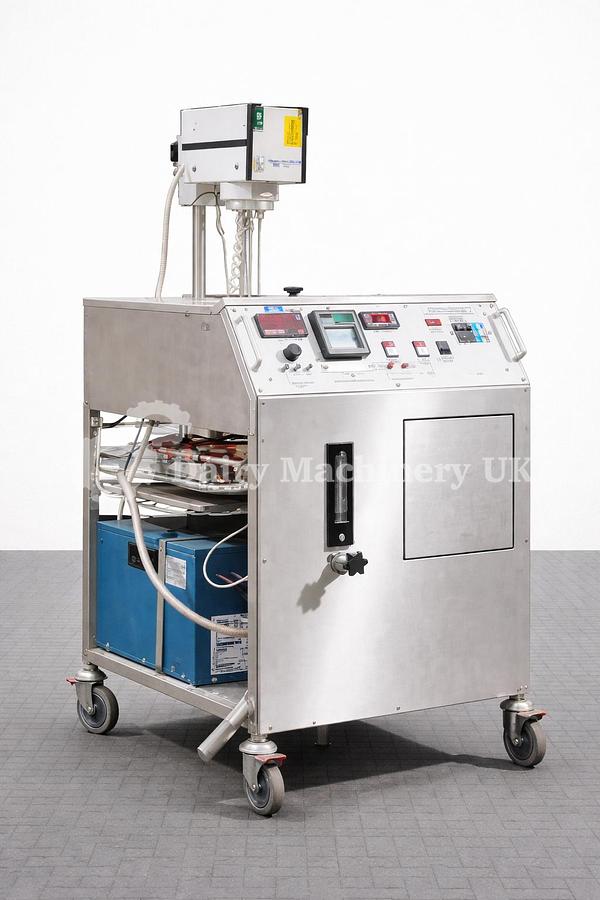
General Overview, Pasteurising, cooling, chilling, curing, emulsifying, reconstituting, incubating and mixing are all processes essential in the food processing laboratory. The Armfield Multi-Purpose Processing Vessel is capable of carrying out all of these functions as a self-contained,mobile unit. Its mobility allows it to be positioned in the laboratory adjacent to other equipment that it may be acting as a service to, and also makes it easily stowable. The hygienically designed jacketed vessel has a working capacity of between 10 and 15 litres which allows experimentation and demonstrations without the need for large quantities of raw materials. An electrical heating element positioned at the base of the jacket heats water in the jacket which in turn heats the contents of the vessel. This method gives a gentle, transfer of heat to ingredients that are often heat sensitive and local hot spots are avoided due to the convective distribution of the heat. Cooling is accomplished by simply metering water from a domestic supply through the, jacket. Chilling involves the circulation of chilled water in a closed circuit through an ice bank circulator incorporated in the base of the unit. An emulsifier having a variable speed drive and several options of emulsor head can be, lowered into the process fluid. Hands-on experience can be gained by students and full instrumentation allows a complete record of the process to be compiled. An automatic valve changeover system enables uncomplicated operation requiring the student/trainee to simply select the particular process required rather than have to operate an array of manual valves., Description, Where necessary, refer to the drawings in Equipment Diagrams section 8., 9.1 Overview, The stainless steel jacketed vessel (1) has a polished, hygienic finish and a working capacity of between 10 and 15 litres. Its contents are heated indirectly by cartridge heater (16) in the base of the jacket. The heater is protected from over-temperature by a thermostat (17) adjacent to it. An emulsifier (2) can be lowered into or raised out of the vessel using the locking handle (5). The on/off and variable speed control (14) of this unit are situated on the motor housing and not on the control console. A green running light (7) indicates when the emulsor motor is switched on. The emulsor head (3) can easily be interchanged with any of the alternatives supplied by simply removing the finger-nuts securing the head to the drive shaft. A lid (6) is provided to prevent any airborne contamination during long periods of heat treatment. Chilled water is circulated from an ice bank unit (12) situated beneath the processing vessel. After a period of time required to build up an ice bank, this will provide chilled water to the vessel jacket, cooling the contents to a temperature suitable for storage/curing. The ice bank is usually used after an initial rapid cooling by circulating cold water from a domestic supply. 3-way valves (10) and (11) are used to automatically select either open, circuit domestic supply cooling or closed circuit chilled water cooling. In both cases the water passes through a flowmeter (13) where the flow rate can be adjusted manually by control, valve (14). From the flowmeter, the water enters the base of the vessel jacket after passing through an in-line non-return valve (15). The water leaves the jacket diagonally opposite the inlet, at the top of the vessel. A pressure relief valve is incorporated in the cooling water supply at the inlet to the jacket of the vessel. This is to prevent any pressure damage occurring to the jacket in the event of the outlet being blocked. The relief valve is pre-set and must not be adjusted. Thermocouples (8), (18) and (20) are positioned to provide accurate temperature indication on the control console. When positioning the equipment in a laboratory, brakes on two wheels (21) can be locked by, moving the brake lever down towards the wheel, preventing accidental movement., Mixer: Silverson High Speed Vortex Mixer , Usage: Processing Tank with Mixer for Laboratory , Capacity: 40 Litres , Previously Used: University For Food Processing , Condition: Good , Spare parts: Armfield UK
Demander des informations sur cette machine
Votre demande est transmise directement au vendeur de cette machine.